

Presented by Rebel Growth Labs · Written by Acesa Garrard · 6 min read
Hey there,
$347,499.
That is what a general contractor out of Boise had already earned and had not collected.
Not bad debt. Not deadbeat customers.
His collection rate was 96.8%. When he sent a bill, he got paid.
He just was not sending them.
That is the part that stuck with me. This was not a sales problem. It was not a lead problem. The work was good, the customers paid, the operation ran.
The money was already his. It was sitting in places nobody was looking.
Earned money goes quiet in three places
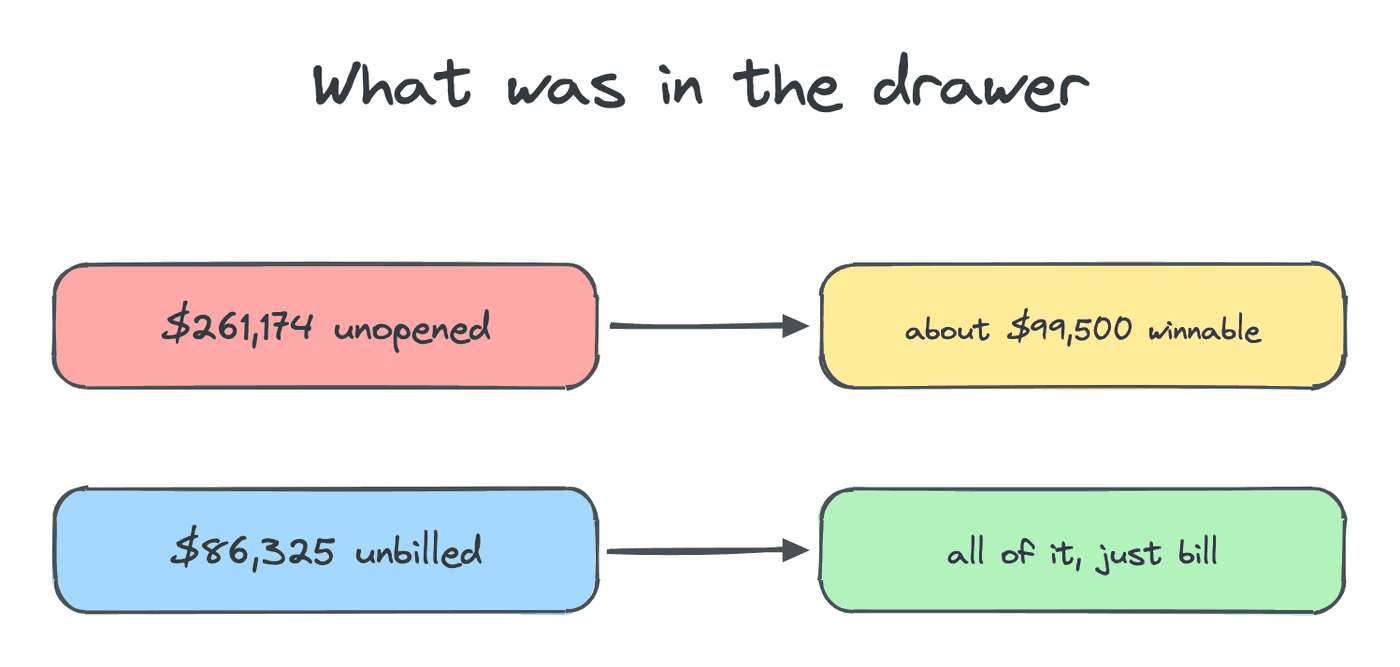
Sent and never opened. $261,174 in estimates. Quoted, sent, waiting on a call back that was never coming. One of them had been sitting 55 days.
Done and never invoiced. $86,325 of finished work. Billing lag, nothing worse than that. Nobody was watching the gap between "job complete" and "bill sent."
Talked, then drifted. The people from the last ninety days who called, got a number, and went quiet.
Every one of those was a real buyer who already raised a hand.
Same summer, a CPA firm out of Dallas. Different industry, different state. Same three drawers.
What the drawer was actually worth
Here is the part that changes how you treat that pile.
On the estimates that actually got a decision, he closed 38.1%. That is his own number, on his own work.
So the $261,174 was never $261,174 of revenue. Run it against his own close rate and it is roughly $99,500 of winnable work.
The $86,325 is a different animal. Nobody has to say yes to that one. The work is done. It is a bill.
Add them and that drawer was worth somewhere around $186,000. Not a projection. Not a promise. His own numbers, applied to his own pile.
Your version is two lines of math. Take your unopened estimate total and multiply it by your close rate on the estimates that got an answer. Then add every dollar of finished, unbilled work at full value, because that money needs no persuasion at all.
That number is what your follow-up is worth. Most owners have never once put a figure on it.
The Drawer Check
Fifteen minutes. Three lists. Work them in this order, because it is fastest cash first.
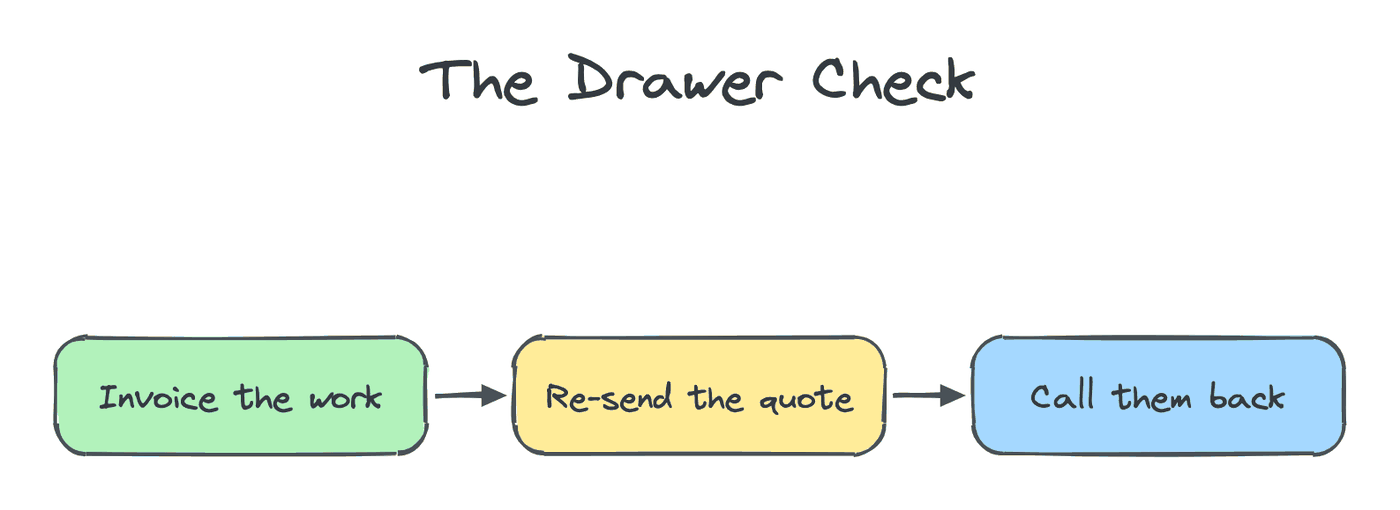
1. Invoice the finished work. Today.
Pull every job marked complete in the last ninety days. Match it against invoices actually sent.
Two lists, two places. Your job board or scheduler, filtered to complete. Your accounting tool, filtered to invoices sent. Put them side by side and the gap shows up in about four minutes.
The gap is money you already earned.
The work is done. It is delivered. Send the bill.
If sending it feels awkward, it is not. One line on top:
"Job's wrapped and everything looks good on our end. Invoice attached, same terms as the quote. Thanks again for the work."
This is the fastest cash in your business and it takes zero persuasion. Nobody has to be sold. They already bought.
2. Re-send the unopened estimates
Pull every quote you sent in the last ninety days that never got an answer.
Most estimate tools will tell you which ones were never even opened. Sort by that if you can. Those are the coldest looking and the easiest to fix, because the customer never made a decision. They never saw it.
This is not a follow-up sequence. It is one line on top of the same estimate you already sent:
"Wanted to make sure this didn't get buried. Still happy to walk you through it."
No guilt. No pressure. One sentence.
An estimate that sat 55 days is not a no. It is unread.
And here is how you know. When his estimates did get a decision, the median time to that decision was three days.
Three days. Not fifty-five.
People who are considering your quote decide fast. The ones sitting for weeks are not weighing it. They never saw it.
3. Call the almost-customers
The ones who talked to you, got a number, and drifted.
If you have a CRM, this is every lead from the last ninety days with no won or lost marked on it. If you do not, it is your call log and your text messages. Ugly works. The list is what matters.
They already know you. They already told you what they wanted. They already sat through the pitch.
You are not pitching them. You are closing a loop you left open:
"I sent you a number a while back and then I went quiet on you. That one's on me. Are you still looking at this, or did you already get it handled?"
That second half matters. Give them the easy out, and the ones who are still live will tell you so themselves.
That is the warmest list you own, and working it costs you nothing but the calls.
What it fixes: the money you already earned stops sitting still.
What it costs: fifteen minutes and three lists.
What breaks without it: nothing loud. It just stays in the drawer.
The honest half
Working the drawer once is a one-time collection. I am not going to dress it up as more than that.
The reason that money piled up is that nobody owned the handoff between "quote sent" and "someone follows up." That handoff was a person remembering, and people forget when the work gets busy.
So run it today and you get the cash. Change nothing else and the drawer refills by Christmas.
Working it once pays you. Owning the handoff is what keeps it from filling back up.
Most owners never run it once.
Flat Businesses Guess. 3D Businesses Grow.
Two paths from here
Path one: run the Drawer Check tonight. Three lists, fifteen minutes, and you will have a real number before bed.
Path two: let me run the full version. The free Revenue Growth Audit walks your business left to right. What is sitting unopened, what is finished and unbilled, where the handoffs drop. Both of those companies found money in the first hour. The plan is yours either way.
Build it so it runs without you.
Acesa
P.S. Hit reply with your drawer number. Just the total. I read every one, and it is almost never zero.
P.P.S. If you want the estimate half of this put to a real figure before you start dialing, that is exactly what The Silent Pipeline Report does. Two minutes, free.
LinkedIn · Facebook · Instagram · YouTube · X · Website
The Revenue Architect is written by Acesa Garrard and presented by Rebel Growth Labs.
Rebel Growth Labs · Columbus, OH
