

Hey there,
A client signed a few weeks back.
By the time we got on the kickoff call, their logo was already on our landing page. Sitting with the other clients we work with. Like they'd been there all along.
Nobody on my team did that.
One prompt. The AI went out, scraped their logo off their website with a tool called Firecrawl, cleaned it up, and dropped it onto the page.
The whole thing took less time than reading this far.
Why that small thing isn't small
That task used to die in the backlog. You'd delay it until you had time, and it never mattered enough to win the time. Or you'd hire it out, wait three days, and pay for an hour of someone's design queue.
That was the deal for every improvement in your business. Move slow, or pay up.
When you couldn't move at speed, you had to hire it. And when you went to hire it, it cost a fortune.
That deal is dead.
Now you can move at speed AND keep the money. Which means the honest sentence, and I'm saying it about both of us, is this one:
The only thing stopping you from having success is you.
I get to say that because I'm about to show you where I'm failing at it too.
The rule underneath it
The logo is a party trick. The rule underneath it is the whole business model.
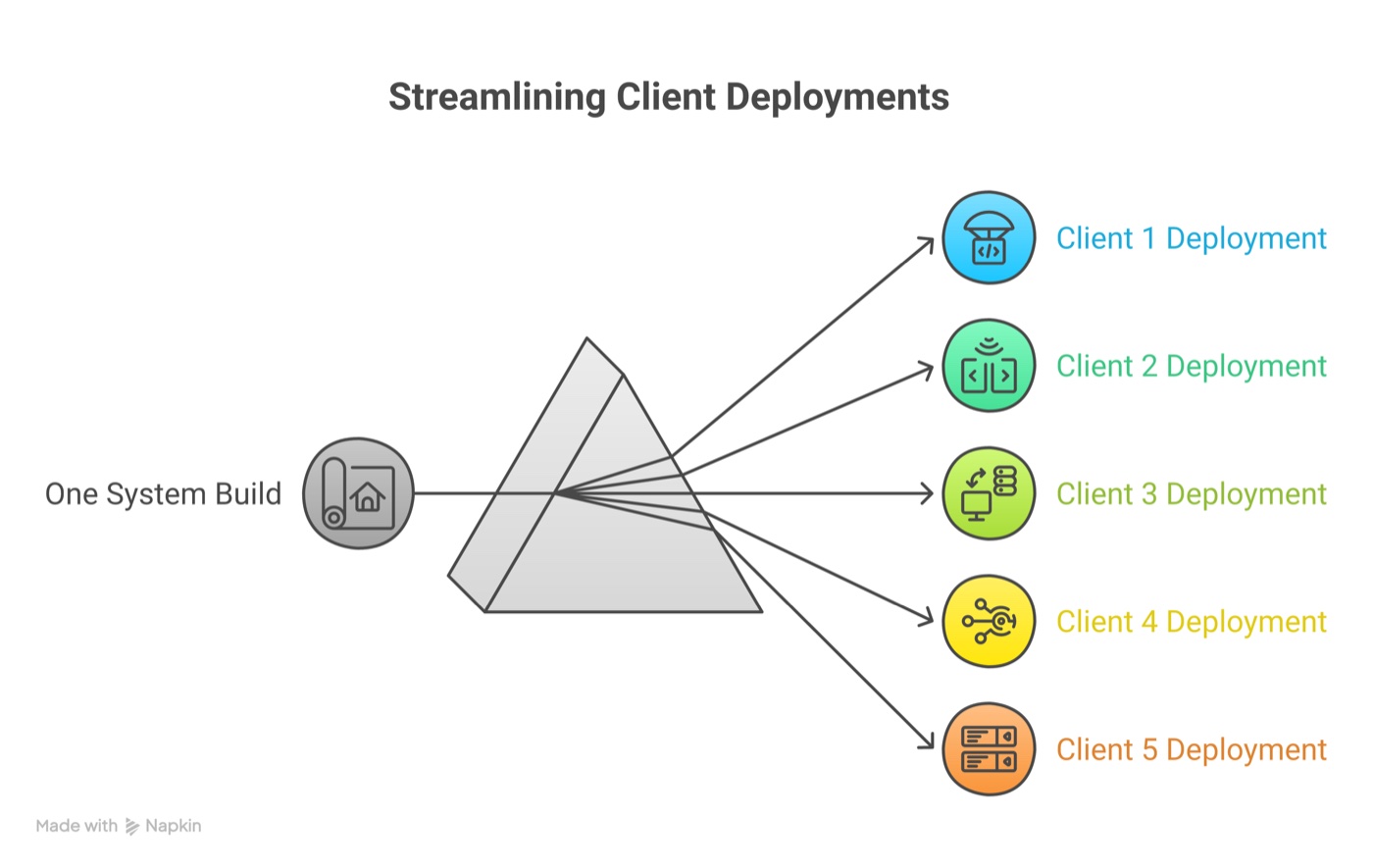
Anything I build for one client, I can multiply across every client almost instantly.
One workflow, built once, deployed everywhere. That's the whole model. A year ago, building what I run today would have cost $50,000 and taken six months. Now it's built in the gaps between calls.
The speed gets the attention. The multiplication makes the money.
So take the rule the way I actually run it.
The Multiplication Rule
Three steps. Run it on your own operation this week.
1. Build it for one real client
Never build in the abstract. Abstract systems solve imaginary problems.
Wait until a real client needs the thing. Build it rough, in the middle of real work, where it has to survive contact with a deadline. That pressure is what makes it worth keeping.
2. Write it down the second it works twice
The first time something works, it's luck. The second time, it's a system trying to be born.
That's the moment you write the prompt down. The exact prompt, the steps around it, what good output looks like. In the AI era, the prompt IS the SOP. If it only lives in your head, all you've got is a memory.
3. Deploy it across the book
Once it's written, push it to every client it fits. Same week, not someday.
If you're wondering what qualifies, it's smaller than you think. The follow-up email you rewrite from scratch every time a quote goes quiet. The onboarding checklist that lives in your texts. The review ask you keep meaning to send. The estimate walkthrough you explain on every single call, with the same three objections in the same order.
None of those feel like systems. All of them are. You've just been paying for them one performance at a time.
Then once a month, sweep your own work and ask one question: what did I do twice this month that should be a workflow by now?
That sweep is where the compounding lives. Miss it and you're just a talented person doing everything manually, faster.
What it fixes: every improvement you make starts landing everywhere at once.
What it costs: the discipline to stop and write things down while the work is loud.
What breaks without it: you become the bottleneck with better tools.
The honest cost
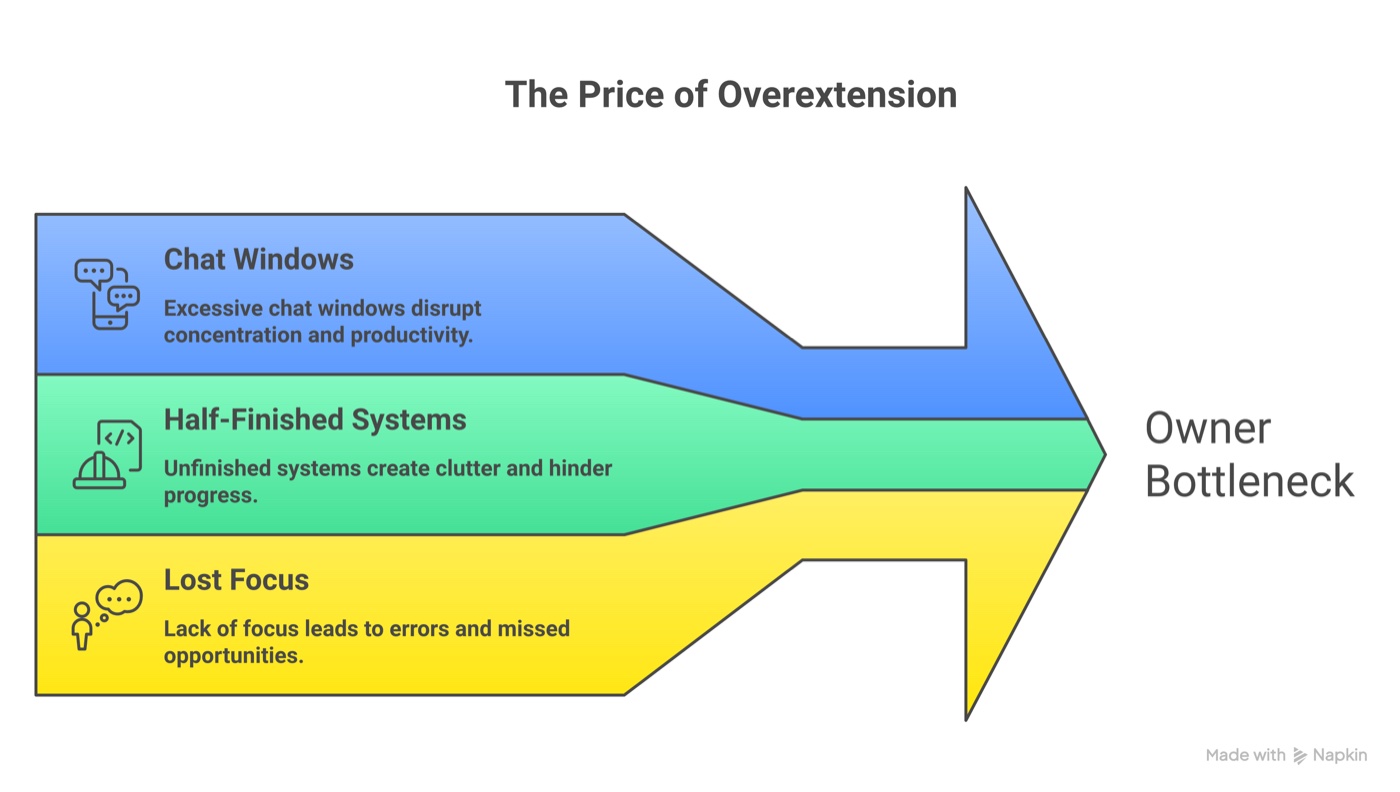
Some days I'll look up and I have 15 chats going at once. Fifteen. And I get lost inside those projects. Where did I leave off? What does this one need from me?
Leverage multiplies whatever you point it at. Point it at a system and it multiplies the system. Point it at chaos and it multiplies the chaos.
Speed has a second edge too, and it cut me this month.
I launched a cold email sequence that has been, quite frankly, piss poor. And I can't even tell you why yet. Is it the copy? Is it the list? I don't know, because my warm channels are producing so much right now that I haven't gone back to look. That's a real sentence from a guy who sells diagnosis for a living.
When you can build fast, you can also abandon fast. Half-finished systems pile up quietly, and every one of them is a small leak dressed up as momentum. The speed didn't create that problem. It revealed it. The bottleneck was me.
And I'll go one further. I still don't have a system around my own content and graphics. My clients are beating me on things I taught them, because I pour the machine into their businesses first and mine gets the gaps.
I'm telling you that so you know the rule applies to the person selling it to you. Every operator has a list of things they're doing manually while they automate everyone else's. What separates drowning from gaining ground is whether that list is written down and getting shorter.
(If you want to see what the full system looks like when it's actually installed, the 3D Revenue Clarity Guide walks the whole framework in plain language. Free.)
What this means for you
You don't need a bigger team this year. You need one list: everything you did twice last month.
Start stupid small. One follow-up email, written once, written well, saved where the whole team can fire it. That's a system. It took you eleven minutes and it works at 2am when you're asleep.
Then the next one. Then the next. The compounding isn't dramatic week to week. It's dramatic quarter to quarter, when you look up and realize the business has been answering leads, sending quotes, and chasing reviews all season without borrowing a single hour from you.
Build each one once. Write it down. Deploy it everywhere it fits.
The hiring excuse is gone. What's left is you.
Flat Businesses Guess. 3D Businesses Grow.
Two paths from here
Path one: run the monthly sweep tonight. List what you did twice, pick the one that stings the most, and build it once properly this week.
Path two: have me find the leaks first. That's the free Revenue Growth Audit. I walk your operation end to end and show you which systems are missing and which order to build them in. You keep the plan either way.
Build it so it runs without you.
Acesa
P.S. Next Tuesday: there was a time the number in my head was $20.25 an hour. This month I quoted $150 an hour, and my own brain fought me the whole way. I'll show you the three moves that got the deal signed anyway.
P.P.S. The 3D Revenue Clarity Guide is the fastest way to see all nine systems in one sitting. Most owners find their missing one in the first ten minutes.
LinkedIn · Facebook · Instagram · YouTube · X · Website
Rebel Growth Labs · Columbus, OH
